AB-100 Decoded (2026): What the Agentic AI Architect Exam Tests
AB-100 replaces four retired Microsoft business-apps certifications. What the agentic AI architect exam tests, its prerequisite gate, and how to prep.

On June 30, 2026, Microsoft retired four certifications at once: MB-335 and MB-700 on the Dynamics side, PL-500 and PL-600 on the Power Platform side. The Supply Chain functional consultant, the F&O solution architect, the RPA developer, and the Power Platform solution architect all reached end of life on the same day. And Microsoft’s own Partner Center announcement names the successor in plain language: those certifications “have collectively been replaced by Agentic AI Business Solutions Architect (AB-100).”
To be precise about what that means: those four certs covered different job scopes, and AB-100 is not a one-for-one successor to any of them. It is the credential Microsoft now offers where the expert and specialist end of the business-apps track used to sit, and the retired tracks point to it rather than to four new specialist exams. That consolidation is the statement. If you held PL-600 as your credential of record, the upgrade path Microsoft provides runs through agents whether your current projects do or not.
I am preparing for this exam now, and the study guide turned out to be a more honest document about what this job is becoming than most of the keynote content on the subject. One calibration before the decode: the blueprint certifies knowledge of tooling that is itself young, and several of the capabilities it tests are weeks past general availability or still in preview, so treat it as a statement of direction as much as of settled practice. What follows is what is actually on the exam, what the weighting signals, the sharp edges I would want to know before test day, and how I would prepare with a working architect’s calendar.
What Is AB-100? The New Architect Exam and Its Prerequisite Gate
AB-100 is Microsoft’s architect-level certification for agentic AI business solutions, spanning Microsoft 365 Copilot, Copilot Studio, Microsoft Foundry, Power Platform, Dataverse, and Dynamics 365. It sits at the top of the new AB series, requires an existing associate certification before it grants anything, and weights production operations above design.
It is also the exam Microsoft points retired PL-600 and MB-700 holders toward.
The mechanics, from the certification page: 100 minutes, proctored through Pearson Vue, may include interactive components, offered in English only, passing score 700, renewal by a free online assessment every 12 months. Pricing varies by country. There is a free practice assessment to calibrate against, and the skills outline receives a minor update on July 22, 2026, so work from the current study guide rather than a cached course.
The AB-100 prerequisite gate: 14 qualifying certs, and retired PL-600 or MB-700 do not count
AB-100 is prerequisite locked: you must earn at least one of 14 qualifying certifications, or passing the exam leaves you with a score report instead of a credential. The list, grouped (from the certification page’s prerequisite section):
- Dynamics 365 associates (8): Business Central Developer, Business Central Functional Consultant, Customer Experience Analyst, Customer Service Functional Consultant, Field Service Functional Consultant, Finance Functional Consultant, Supply Chain Management Functional Consultant, and Finance and Operations Apps Developer.
- Power Platform associates (3): Power Platform Developer, Power Platform Functional Consultant, and Power Automate RPA Developer.
- AI associates (3): Azure AI Engineer, Azure AI Apps and Agents Developer (currently marked beta), and AI Agent Builder (AB-620).
Read that list carefully, because it contains the catch that will surprise exactly the people this exam is aimed at: every qualifying cert is associate level. The retired expert-tier credentials themselves are not on the list, so holding PL-600 or MB-700 alone does not open the gate; what counts is a qualifying associate. Whether an expired associate still counts is exactly the ambiguity in the callout below. The one retired exam whose certification does appear is PL-500: the Power Automate RPA Developer Associate cert is on today’s list even though its exam retired in June.
Just as important is who should not take AB-100. Microsoft built the AB series with distinct rungs, and climbing the wrong one wastes months. Our Microsoft AI certifications hub maps the whole track; the short version:
| Exam | Certification | Right person |
|---|---|---|
| AB‑900 | Copilot and Agent Administration Fundamentals | Admins and IT generalists running Copilot and agents in a tenant |
| AB‑730 | AI Business Professional | Business users applying AI at work |
| AB‑731 | AI Transformation Leader | Executives owning AI strategy |
| AB‑620 | AI Agent Builder Associate | Makers and developers building Copilot Studio agent solutions |
| AB‑100 | Agentic AI Business Solutions Architect | Architects designing and, above all, operating agentic solutions end to end |
There is also a commercial forcing function. Per the same Partner Center announcement, four things change in July 2026:
- The specialization is renamed to the Microsoft 365 Copilot specialization
- The MS-102 certification requirement is removed
- The old Applied Skills requirements retire at the end of June 2026
- AB-100 plus AB-620 are added as new certification requirements
Partners who want that specialization have to staff these credentials, which puts a floor under demand that has nothing to do with individual career choices.
Independent cert-watchers reached the same reading of the wave: Vlad Catrinescu’s 2026 retirements guide frames AB-100 as the recommended path forward for PL-600 and MB-700 holders and flags the partner-designation risk for firms that do not transition their certified staff.
AB-100 Exam Weighting: Why Deploy Beats Design
The exam has three domains. Plan sits at 25 to 30 percent, Design at 25 to 30 percent, and Deploy at 40 to 45 percent: the domain about running agents in production outweighs the one about designing them by a wide margin, and four of its subsections are monitoring, testing, ALM, and responsible AI with security and governance.
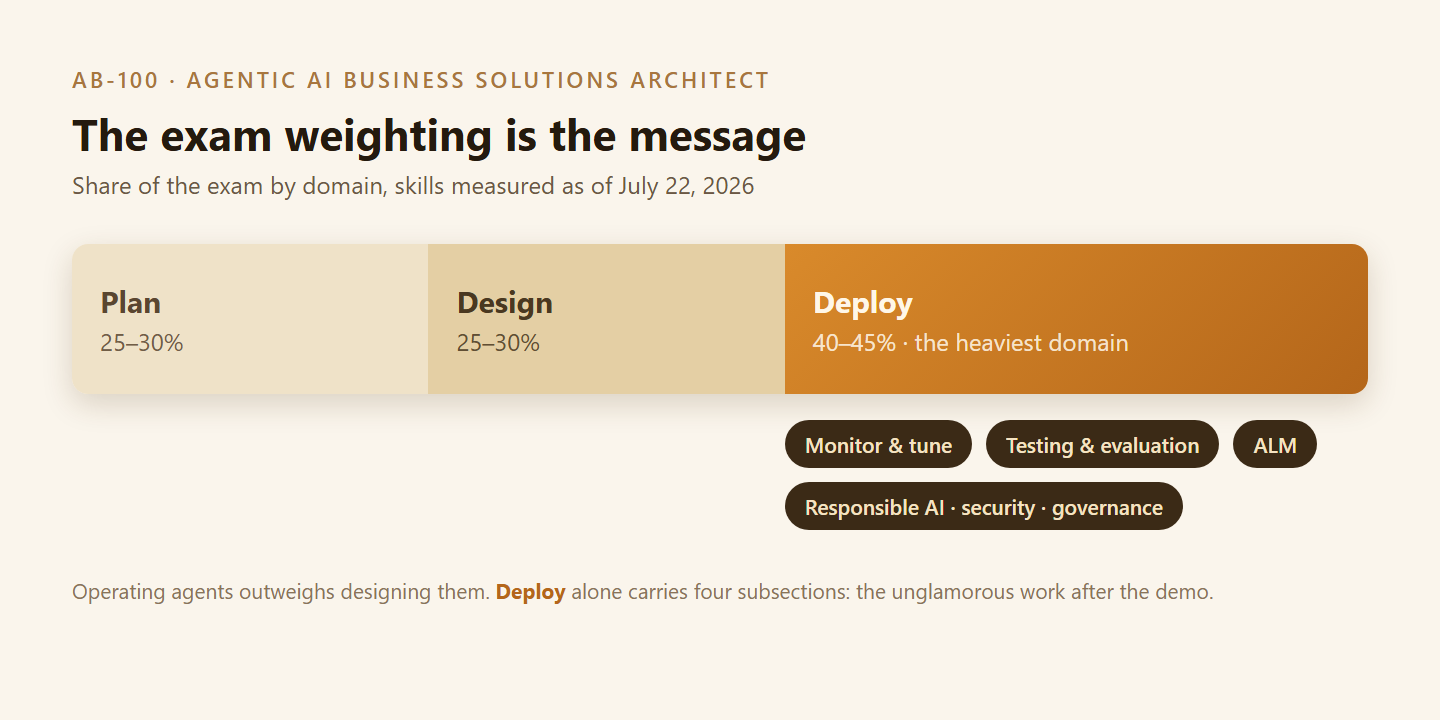
I find that weighting quietly remarkable. The industry demo culture celebrates the design moment: the clever orchestration, the multi-agent diagram, the tool-calling loop. Microsoft’s own architect exam says the job is mostly what happens after: whether you can tell a healthy agent from a degrading one, whether you have an evaluation practice instead of a vibe check, whether your deployment survives moving from dev to prod, and whether security holds when a malicious document lands in the agent’s context.
Four Deploy-domain details, pulled from the official study material, illustrate the level it tests at:
- Evaluation targets 80 to 90 percent, not 100. Microsoft’s agent-evaluation checklist sets a realistic pass-rate band for probabilistic systems and tells you to run test sets multiple times. Copilot Studio ships seven built-in evaluation methods, and the details discriminate: the general-quality method needs no expected answer while every match and similarity method requires one, and evaluation results are retained for only 89 days.
- A near-perfect score is a defect signal, at least in AI Builder. AI Builder’s model grading treats grade D as double-sided: a prediction model can fail by being worse than random or by scoring 99 percent plus, which usually means an overfit model or a leaked column. The exam expects an architect who reads “99 percent accurate” on that report as a warning, not a win.
- Monitoring is persona-matched, not one dashboard. The governance guidance routes makers to Copilot Studio analytics, developers to Application Insights, admins to the Power Platform admin center, and security teams to Sentinel. The retention traps are exam bait and production bait alike: reactions and comments keep 28 days, transcript downloads 29 days, analytics views 360.
- ALM is a trap inventory. Solutions move metadata, never data. Copilot Studio keeps a documented list of settings that are not solution-aware and must be redone per environment, from Application Insights wiring to channel security. And fine-tuned model deployments bill hourly even at zero traffic and are deleted after 15 idle days while the model itself is retained. The exam wants the architect who knows where deployments actually break.
If you have been reading this site, that emphasis will sound familiar. The case for a standing evaluation practice and a per-run spend guard is not editorial preference anymore; it is what Microsoft’s own architect exam tests.
What Microsoft Thinks an Agentic AI Architect Is
Studying the full blueprint, five signals stand out about the role Microsoft is actually certifying.
Copilot Studio is the center of gravity
The credit economics, the orchestration modes, and the evaluation and governance detail overwhelmingly live in Copilot Studio. The Cloud Adoption Framework strategy guidance the exam draws from is explicit about the build ladder: buy a SaaS agent if one meets the functional requirements, extend with low-code before building, and treat pro-code as the escalation rather than the default. Where Foundry does appear, the exam wants the boundary: which agent workloads belong in hosted versus in-process versus Copilot Studio. The architect this exam certifies is buy-then-extend-then-build, in that order.
The architect owns the money
Microsoft’s own ROI guidance is exam material at the level of actual numbers. The agent business-value framework computes agent-assisted value as assisted hours times an hourly rate, defaulting to 72 dollars per hour based on U.S. Bureau of Labor Statistics compensation data, and it requires the baseline to come from telemetry rather than surveys. Treat the default as a starting point that flatters the case; substitute your own loaded rate before you show the math to a CFO. Consumption is priced in Copilot Credits, and the blueprint expects you to know the rate card, not just that one exists:
| Metered thing | Credits |
|---|---|
| Prepaid capacity pack (monthly) | 25,000 credits |
| Classic answer | 1 |
| Generative answer | 2 |
| Agent action | 5 |
| Tenant graph grounding query | 10 |
| Agent flow actions (per 100) | 13 |
Enforcement behavior differs by feature (the sharp-edges table below carries the thresholds), and pay-as-you-go never enforces a stop, which is the same class of problem as the spend caps that do not actually cap. We keep a deeper teardown of the credits model in the Copilot Credits billing decode, and the ROI framing pairs with our Copilot ROI calculator piece. This is FinOps material, and the blueprint treats it as core architect knowledge rather than an afterthought for procurement.
The architect owns agent identity
The identity story splits by tier, and the split is the point.
- Low code, per-agent identity. Every new Copilot Studio agent gets an auto-provisioned Microsoft Entra Agent ID, mandatory for new agents since July 2026. The identity doc’s distinction is worth memorizing: the identity’s scopes describe what an agent is configured to do, while access-control and DLP policies decide what it is allowed to do at the moment of execution, revalidated at every connector call. Conditional Access enforcement on agent identities currently applies only in the Teams channel, a scoping detail worth knowing before you promise it everywhere.
- Pro code, per-project identity. In Foundry, all agents within a single project share the same managed identity, so least privilege forces a separate project per distinct access pattern. That is a wider blast radius by default than the low-code tier, and exactly the kind of detail that separates a working deployment from an audit finding.
On the attack side, the blueprint covers defense against indirect prompt injection in layers:
- Prompt shields screening documents and other untrusted content
- Spotlighting to separate instructions from data
- Guardrails at the tool-call boundary
- A human in the loop for consequential actions
Treat the stack as risk reduction, not prevention: assume an injection succeeds sometimes and design the blast radius accordingly. Status calibration belongs here too: the Agent ID platform went GA in April 2026, while several surrounding governance features are still in preview. My read of the balance: cost governance and agent identity are the blueprint’s two obsessions, while data science barely appears.
Microsoft-governed does not mean Microsoft-only
The blueprint normalizes Salesforce, ServiceNow, and Zendesk as systems the agents serve, and Anthropic’s Claude models appear inside the Azure model router and computer-use scenarios. Status matters here: the router itself is GA, while its Claude-model support is in preview, and Claude models must be deployed separately before the router can use them. The exam expects you to know multi-vendor mechanics, not just tolerate them.
The most repeated lesson is restraint
The planning guidance opens with elimination logic: structured, rule-bound work goes to code or non-generative automation; static question answering over a fixed corpus goes to classic retrieval; an agent is justified only for multi-step, adaptive, many-tool work. Agent flows are deterministic on purpose despite the name. Multi-agent designs are gated behind real conditions like security boundaries and separate owning teams. For a certification named agentic AI, the single strongest through-line is knowing when not to build one, which is the same lowest-rung-that-works elimination ladder we have argued for here, now with an exam number attached.
A Worked Example: An Invoice-Dispute Agent, the Way AB-100 Thinks
Here is the blueprint’s instinct applied to a request every business-apps architect has heard some version of: “Finance wants an agent to handle vendor invoice disputes.” Walk every slice down the elimination ladder before you accept the word “agent.”
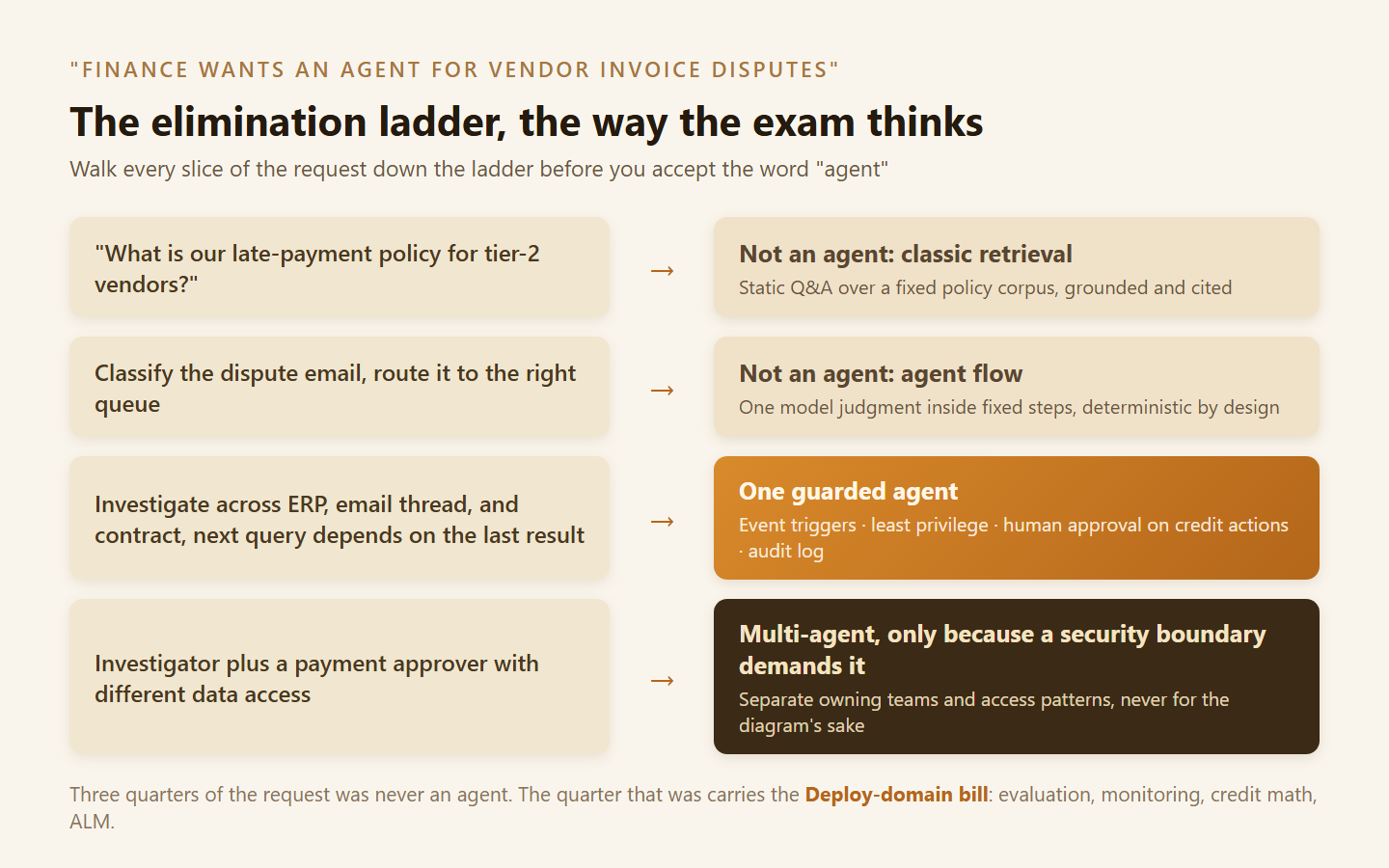
- The lookup slice is not an agent. “What is our late-payment policy for tier-2 vendors” is static question answering over a fixed policy corpus (in this stack, grounded knowledge sources in Copilot Studio or an Azure AI Search index). That is classic retrieval, grounded and cited, and building an agent for it buys non-determinism with no payoff.
- The triage slice is not an agent either. Classifying an incoming dispute email and routing it to the right queue is one model judgment inside fixed steps. That is an agent flow: deterministic by design despite the name, billed per action through Copilot Studio consumption, no orchestration loop anywhere.
- One slice is genuinely agent-shaped. Investigating a disputed invoice across the ERP, the vendor’s email thread, and the contract terms, where the next query depends on what the last one returned, cannot be drawn as branches in advance. That slice earns an agent, with event triggers, least-privilege access, a human approval on any credit action, and audit logging, which is precisely how the blueprint scopes autonomous agents.
- Multi-agent is gated, not default. The blueprint’s conditions are concrete: a security boundary to respect, separate owning teams, planned growth. A dispute investigator and a payment approver with different data access qualify. Splitting one workload into five agents because the diagram looks impressive does not.
Then the Deploy domain takes over, because the exam’s real question is not “can you design this” but “can you run it”:
- A labeled evaluation set with an 80 to 90 percent pass band, re-run on every prompt or tool change
- Monitoring routed to the right persona per surface
- Credit consumption modeled before the pilot, not after the invoice
- Dev-to-prod through solutions, with the not-solution-aware settings on a per-environment checklist
That is the exam in miniature. Three quarters of the request was never an agent, and the quarter that was carries an operations bill the demo never shows.
AB-100 Sharp Edges Worth Knowing Before Test Day
A handful of product facts from the study material are both likely exam discriminators and genuinely useful at work. Each traces to current Microsoft Learn documentation, and GA-versus-preview status is tagged where it matters. Two rows deserve their sources up front. Computer use is GA, billed per step, and its hosted browser is documented as not for production use; the credit enforcement thresholds come from the same consumption doc as the rate card above.
| Area | The detail that separates a pass from a guess |
|---|---|
| Model router | The model subset you configure doubles as the failover set. Configure a single model and you silently have no failover. Claude support is preview, and Claude models must be deployed separately first. |
| Evaluation (GA) | Seven built-in test methods in Copilot Studio; only the general-quality method works without an expected answer. Results retain 89 days. |
| Analytics retention | Reactions and comments 28 days, transcript downloads 29 days, analytics views 360 days. Long retention means exporting to Dataverse, not hoping. |
| AI Builder grading | Grade D flags both worse-than-random and 99-percent-plus models. Near-perfect accuracy usually means a leaked column. |
| Fine-tuned models | Storage is free, but a deployment bills hourly at zero traffic and is deleted after 15 idle days. The model survives; the endpoint does not. |
| ALM | Solutions move metadata, never data. App Insights settings, manual authentication, channel security, and sharing are not solution-aware and must be redone per environment. |
| Credits enforcement | Whole-agent disablement triggers at 125 percent of prepaid capacity, but agent flows block at 100 percent, and pay-as-you-go never enforces a stop. |
| Computer use (GA) | Billed per step, 5 credits standard and 15 premium; the hosted browser is explicitly not for production use. |
None of these are trick knowledge. Every row is a production incident waiting for a calendar date, and I have watched close cousins of two of them: an analytics window that quietly expired before the retrospective that needed it, and an idle fine-tuned endpoint billing for weeks at zero traffic because nobody knew hourly billing survived zero usage.
How to Prepare for AB-100: A Three-Week Plan With a Day Job
The exam’s own material points the way, and the weighting tells you where the hours go. Here is the plan I am running, sized for a working architect at roughly eight to ten hours a week over three weeks.
| Week | Focus | Hours | Done means |
|---|---|---|---|
| 1 | Deploy domain: monitoring personas, the seven evaluation methods, ALM traps, responsible AI and agent identity | ~10 | One trial-tenant agent taken through evaluation runs, solution export, and import into a second environment |
| 2 | Design domain: orchestration modes and what each unlocks, first-party Dynamics 365 agents, extensibility boundaries | ~8 | You can say from memory which capabilities require generative orchestration and which first-party agent maps to which scenario |
| 3 | Plan domain plus calibration: CAF AI strategy, ROI and credit math, then the free practice assessment | ~6 | Practice assessment comfortably above the passing threshold before you book |
Three notes on the plan:
- Clear the gate first. Check the 14-cert list above against your Learn profile and confirm your qualifying associate cert is current. If you hold none, AB-620 or AI-103 are the natural on-ramps depending on whether you live in Copilot Studio or in code.
- Study Deploy first, not last. It is the heaviest domain and the least demo-friendly, and hands-on beats video for it: a trial tenant with Copilot Studio, one agent taken through evaluation runs, solution export, and a second environment teaches the testing and ALM subsections better than any course. Work from the official study guide outline and read the linked product docs, because the discriminating details live there, not in summaries.
- Mind the outline date. The skills outline gets a minor update on July 22, 2026, so pull the current study guide rather than a cached course. As of this writing, third-party prep courses for AB-100 barely exist, which cuts both ways: no shortcut courses, but also no stale ones. The primary docs are the actual source of truth.
What AB-100 Does Not Certify
Honesty about the boundary keeps the credential useful:
- Not the retired certs’ depth. It does not replace the domain depth of MB-335 supply-chain work, MB-700 F&O architecture, or PL-500 RPA engineering; those bodies of knowledge no longer have a dedicated exam.
- Knowledge of operations, not operating experience. It certifies that you know the controls, evaluation methods, and traps exist, not that your evaluation sets, data hygiene, and spend guards actually hold in your tenant.
- Not Azure platform architecture. Landing zones, networking, and workload architecture remain AZ-305 territory, which lives outside the business-apps track and is unaffected by this wave.
- Not a project filter. Passing it does not make agents the right answer for your project mix; the exam itself spends its planning domain teaching the opposite.
The Verdict: Is AB-100 Worth Taking?
For architects who built careers on PL-600-era credentials, yes, with eyes open: AB-100 is the continuation of the role’s credential line rather than an optional specialty. It is the only architect-tier credential Microsoft now offers where those four used to sit within the business-apps track. Whether employers and clients treat it as required is a market outcome that will take a year to observe; what is already fixed is the partner-specialization requirement and the absence of an alternative in this track. The content itself is a fair, occasionally blunt statement of what the role now requires: agent restraint at planning time, product-boundary fluency at design time, and operations, evaluation, cost control, and security discipline above everything else.
One caveat belongs next to the credential: the exam tests that you know the operational controls exist, not that yours work. Pair it with a standing evaluation set, honest baselines, and a spend guard, or it certifies a vocabulary.
That said, the emphasis is the encouraging bit. The exam does not certify enthusiasm. It certifies the unglamorous operational competence that separates the agent that survives contact with production from the one that becomes next quarter’s writedown. If your instinct on agentic AI has been to ask what could go wrong before what could be automated, this exam was written for how you already work.
Exam facts verified against Microsoft Learn on 2026-07-11. AB-100’s skills outline receives a minor update on 2026-07-22; check the study guide for the current version before booking.
Stay in the loop
Get new posts delivered to your inbox. No spam, unsubscribe anytime.
Related articles
When Not to Build an AI Agent: A 5-Question Test (2026)
Before you build an AI agent, run five questions. When a flow, a query, or nothing at all beats an agent, with worked examples and the agent tax to budget.
Your AI Agent Project Is Really a Data Project: The Data-Prep Tax
AI agent projects are really data projects. Why data preparation and upkeep, not the model, decides whether an agent ships, and how to scope the data work first.
Microsoft's Agents Hub Decoded (2026): The Frameworks and the Gaps
Microsoft's new Agents hub formalizes agent architecture, archetypes, a maturity model, and evaluation. An architect's read on what it still leaves to you.