The Six Agentic Adoption Patterns: A Practitioner Decode of Microsoft's New Playbook (2026)
A practitioner read of Microsoft's Agentic Transformation Patterns Playbook: six patterns, the 5x5 maturity model, CoE structures, what it understates.

Microsoft just published a 52-page framework that almost no one in your steering committee has read yet. This is the practitioner read on what it gets right, what it leaves unsaid, and how to use it without becoming its captive audience.
The Agentic Transformation Patterns Playbook came from the Microsoft Copilot Acceleration Team in April 2026. It is the most operating-model-centric Microsoft framework I have seen for enterprise AI, distinct from the model-selection and product-adoption guidance Microsoft published through 2024-2025. Treat it as v1 of a still-refining artifact, not a validated standard: it is five weeks old at writing, authored by one team, and the field has not yet had a deployment cycle long enough to test the prescriptions. The framework’s whole thesis is on page 52:
“Agents don’t scale through technology. They scale through people, ownership, and operating discipline. You don’t need a bigger model. You need a better operating model.”
That sentence holds up to a senior read. The rest of this article is how the framework holds, where it understates the difficulty, and how to use it.
Two calibrations before going further. First, the framework leans on Microsoft surfaces at mixed maturity. Plan accordingly: Patterns 1-3 sit on GA surfaces and ship today; Patterns 4-6 depend on capabilities still hardening.
Second, the playbook reflects one team’s framing at one point in time. Competing taxonomies exist. The value here is the operating-model framing, not the patterns themselves as a settled industry standard.

The Assist to Execute Shift
The playbook opens (page 3) with a single conceptual shift it argues changes everything downstream. AI agents are moving from assisting humans to executing work. In Assist mode, the agent supports a human decision, and the human is fully accountable. In Execute mode, the agent performs work across systems, makes decisions, orchestrates workflows, and the human shifts to overseeing outcomes rather than producing them.
The shift creates four new demands:
- Ownership: who is accountable for this agent
- Risk: what happens when it goes wrong
- Lifecycle: who maintains and improves it over time
- Governance: what it is allowed to do and not do
Those four demands are the entire reason the rest of the playbook exists. If your agents are still in pure Assist mode, the operating-model overhead of the framework is mostly overkill. Once any agent crosses into Execute, the playbook’s vocabulary becomes useful scaffolding for the operating-model conversation that has to happen.
What the playbook leaves unsaid is the schema question. Execute mode demands a canonical schema for the work being done, owned by someone with authority across the systems the agent touches. The playbook implies this in its CoE section but never names it as load-bearing. I have argued elsewhere that schema ownership is the architectural foundation under which the rest of any orchestration plane has to sit. See the companion piece on AI orchestration over legacy systems for the reference architecture that takes that idea to its logical end.
Six Adoption Patterns, Not Stages
The framework’s central contribution is naming six distinct adoption patterns. The point Microsoft makes repeatedly is that these are design choices, not maturity stages. You do not progress from Pattern 1 to Pattern 6 in sequence. Most enterprises pursue 2-3 patterns simultaneously, and each pattern demands its own governance, ownership, and maturity depth.
Here are the six, with the kind of agents they describe and what they actually look like in practice:
| Pattern | What it does | Where it lives |
|---|---|---|
| 1. Employee AI Enablement | Individual productivity assistants that draft, summarize, research, and automate personal workflows. Humans retain decision authority. | M365 Copilot in Word, Excel, Outlook. Teams chat assistants. Personal flows. |
| 2. Business Expert Empowerment | Scaling SME judgment via agents that answer domain questions, interpret guidelines, and surface expert knowledge on demand. Expert remains accountable for credibility. | Policy and compliance Q&A. Engineering standards. Risk assessment support. Regulatory interpretation. |
| 3. Workplace & IT Services | Agents that handle intake, triage, and end-to-end execution of internal services. Service owners govern; agents operate. | IT helpdesk. HR services. Finance. Facilities. Procurement workflows. |
| 4. Core Business Process Transformation | Agents that orchestrate complex revenue-impacting workflows across multiple systems. Routine decisions autonomous; exceptions escalate. | Claims processing. Order-to-cash. Financial close. Manufacturing quality. Supply chain. |
| 5. External Engagement | Customer- and partner-facing agents that cross the enterprise trust boundary. Every interaction affects brand. | Customer support. Digital concierge. Partner enablement. Status tracking. Vendor onboarding. |
| 6. AI-First Capabilities | Net-new capabilities built around agent loops. Sense, decide, act, learn. Things that were not possible before AI. | Continuous optimization engines. Fraud detection. Market sensing platforms. Predictive planning. Autonomous workflow generation. |
In my read, most enterprises will find themselves cleanly inside Patterns 1 and 2, struggling honestly with Pattern 3, and overreaching into Patterns 4 and 5 before they have the maturity. Pattern 6 is for organizations that have already shipped autonomous agentic systems into production at least once and are building new business capabilities on top; in our read, outside digital-native orgs and based on the field maturity we see today, most enterprises are 18-36 months away from a real Pattern 6 deployment.
The pattern-vs-stage distinction is the playbook’s most underappreciated insight. Many CIOs will read the list and conclude they should do Pattern 1 first, then graduate to Pattern 2, and so on. That is wrong. The patterns are different design choices for different work, and you choose based on what you are trying to do, not based on where you sit on a maturity curve.
The 5x5 Maturity Model
The playbook then introduces a maturity model (Section 2, page 25 onward) that is meaningfully different from the typical “Initial, Repeatable, Defined, Capable, Optimized” five-rung ladders that have dominated enterprise frameworks since CMM. The Microsoft version is a 5x5: five capability drivers (AI Strategy & Experience, Business Strategy, Governance & Security, Technology & Data, Organization & Culture) crossed with five maturity levels (100 Initial, 200 Repeatable, 300 Defined, 400 Capable, 500 Optimized).
The model’s strongest contribution is the explicit acknowledgment that 500-everywhere is not the goal. Different patterns demand different target maturity profiles. An Employee Enablement pattern can succeed with 200-300 across most drivers and a 300 in Organization & Culture. A Core Business Process Transformation pattern demands 500 in Strategy and Business Strategy, 400 across Governance, Technology, and Culture. The match between pattern and target maturity is the framework’s primary diagnostic.
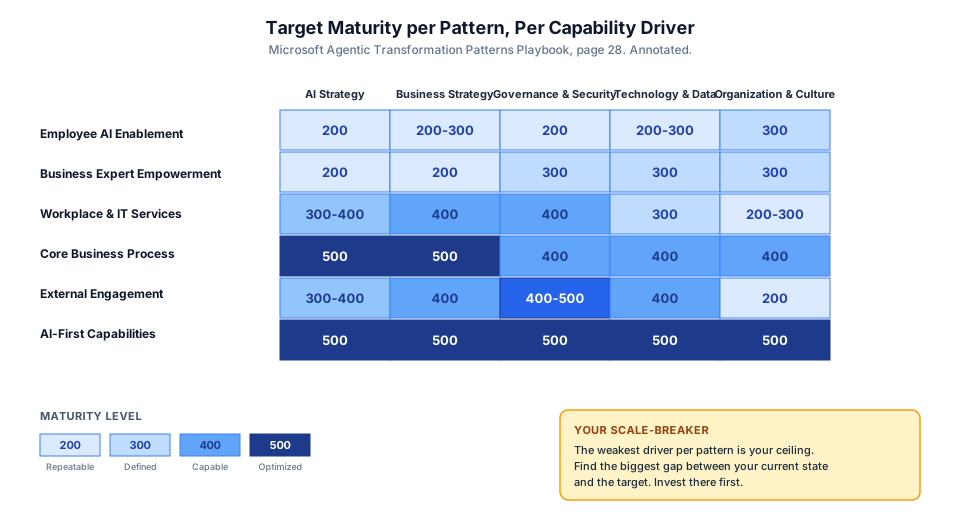
The concept the playbook calls a “scale-breaker” is the most operationally useful part of the framework. Your weakest capability driver becomes your ceiling, regardless of how strong the others are. An enterprise sitting at 100/300/400/200/100 across the five drivers cannot scale Pattern 4 (which needs 500/500/400/400/400) because of the 100 in Organization & Culture and the 100 in AI Strategy. The 400 in Governance is wasted capacity until the other drivers catch up. The diagnostic tells you where to invest first: not where to spend the most, but where to close the gap that blocks scale.
Where the model is honest: it admits that “most organizations are a patchwork” and that the unevenness is exactly where scale breaks. Where the model is silent: organizational politics. The 5x5 does not capture the political maturity to enforce schema decisions across team boundaries, to name a single accountable owner across functions that have never shared one, or to defund a high-visibility pilot that is not producing results. Those decisions are the actual scale-breakers in most enterprises I have worked with, and they do not show up in any of the 25 cells.
The Top 5 Scale-Breakers
Page 34 of the playbook lists the five most common signals that maturity gaps are blocking scale. Most organizations recognize at least three. The list is genuinely useful as a diagnostic, but each one has an honest interpretation that the playbook understates.
Many pilots, no portfolio. The playbook prescribes picking 1-2 outcomes and 1-2 patterns and naming business owners. The honest add: most enterprises cannot name one outcome owner who has the authority to defund competing initiatives. Until that authority exists, the portfolio discipline is rhetorical.
One-off agents, no reuse. The playbook prescribes standardizing reference architecture, integration patterns, and telemetry. The honest add: this is the schema-contract argument extended. Without a canonical schema owned by someone with cross-team authority, every reuse attempt becomes a negotiation. See AI orchestration over legacy systems for the architecture pattern.
Great demos, low adoption. The playbook prescribes designing golden paths for the top scenarios. The honest add: golden paths require a process owner, not just a UI designer. The most common failure mode is a beautifully designed flow that nobody is empowered to enforce across teams.
Licenses are not usage. The playbook prescribes systematic enablement: role-based training, community, champions, incentives. The honest add: license plus enablement still loses without leadership role-modeling. If the executives do not visibly use the agents themselves, the rest of the organization reads it as theater.
Shadow agents appearing. The playbook prescribes a minimum baseline of named owner, audit trail, release gate, monitoring, and risk-tiered escalation. The honest add: governance baselines catch some shadow agents but not the ones running on personal Copilot subscriptions or third-party tools that never touched your tenant. The playbook is silent on this Tier 0 (agents that exist below the governance horizon). See Shadow AI Governance for Microsoft Enterprises for the discovery side.
The diagnostic value of the list is real. Most steering committees can run through it in 15 minutes and identify two or three signals they have. The fixes are harder than the playbook suggests, but naming the failure modes precisely is the first step.
The CoE Framework: Three Structures, Matched to Pattern
Section 3 of the playbook (pages 35-48) introduces the Center of Excellence as the operating vehicle that turns intent into repeatable execution. The framework names four CoE functions (Govern, Enable, Optimize, Scale) and three structural options (Centralized, Hybrid, Federated). The strongest contribution is the explicit matching of structure to pattern.
| Structure | Best for | How it works |
|---|---|---|
| Centralized | Employee Enablement, Workplace & IT (early), External Engagement | One team sets rules, delivers, and monitors. Maximum consistency and control. Best when you are early, when risk is high, or when agents cross enterprise boundaries. |
| Hybrid | Business Expert Empowerment, Workplace & IT (as it matures) | Central team sets standards and supplies expertise; local teams build within guardrails. Matrix model where the CoE enables rather than controls. |
| Federated | Core Business Process, AI-First Capabilities | Business units own agent outcomes and delivery end-to-end. The CoE provides standards, enablement, and governance by exception. Requires mature teams who can own agent lifecycle independently. |
Most CoEs start centralized and stay there past their useful life. The framework’s matching gives you a clean exit ramp: as patterns mature, the CoE structure should shift to match. A Centralized CoE running Pattern 4 (Core Business Process) at scale is a bottleneck the playbook explicitly warns against.
The framework’s six core CoE roles plus four edge roles (pages 40-41) cover the staffing model honestly:
- Six core CoE roles: Executive Sponsor (strategic), Business Owner (value), CoE Lead / AI Program Manager (operating), Agent Product Owner (product), Platform & Operations (run), Security / Risk / Compliance (trust).
- Four edge roles: Makers, Domain Experts, Service Owners, Adoption Leads.
Page 38 names a 7-stage agent lifecycle (Intake → Triage → Build → Deploy → Monitor → Improve → Retire), and page 42 maps a 10-row RACI across those stages plus overlay activities (agent strategy & prioritization, knowledge curation, release gate, incident response, performance review, retirement). The mapping translates cleanly to existing change-management discipline.
The framework’s strongest contribution is the explicit decision-rights split:
| Centralize (HOW scale works) | Delegate (WHO builds everything) |
|---|---|
| Platform and environment strategy | Domain prioritization (which use cases matter most) |
| Security and compliance policies | Agent design within architecture standards |
| Architecture standards and reference patterns | Knowledge curation (what content the agent uses) |
| Release readiness / go-no-go gate criteria | Day-to-day operations for lower-risk agents |
| Monitoring standards and alerting thresholds | User experience and interaction design |
| Agent risk classification tiers | Domain-specific success metrics and KPIs |
| Autonomy limits | Continuous improvement |
| Responsible AI guidelines | Delivery execution |
Where the framework is weakest: it assumes the existence of an Executive Sponsor with both budget AND political capital. In our experience, you have one or the other in most enterprises, rarely both. The Executive Sponsor role is the role most likely to be assigned to someone who cannot actually fulfill it, and the framework does not name that risk. A future companion piece will go deeper on CoE anti-patterns.
Risk-Tiered Governance
Page 46 of the playbook splits agents into three risk tiers with proportionate controls. This is the cleanest part of the framework and the most directly portable to existing risk management practice.
| Tier | What it covers | Required controls |
|---|---|---|
| Tier 1: Low Risk | Individual productivity agents (drafting, summarization, research) | Named owner. Basic monitoring. Standard release checklist. Self-service deployment within guardrails. |
| Tier 2: Medium Risk | Expert knowledge agents and internal service agents | Named owner plus domain expert validator. Knowledge quality monitoring. Formal release gate with review. Accuracy tracking and feedback loops. |
| Tier 3: High Risk | Business-critical and external-facing agents | Named owner plus formal process owner. Production-grade SLA monitoring. Security review plus responsible-AI assessment. Decision rights framework. Incident response plan. Quarterly maturity review. |
The framework explicitly warns against over-governing low-risk agents (kills adoption) and under-governing high-risk ones (creates liability). That principle is sound and undersold in most governance writing.
One tier the framework misses: Tier 0, agents in personal Copilot subscriptions or third-party tools that never registered with your tenant. These are invisible to your governance plane by definition. The Tier 3 controls do not apply because the agent does not exist in your environment. The discovery problem precedes the governance problem; see again Shadow AI Governance for Microsoft Enterprises for the discovery-side companion.
The 90-Day Play
Section 4 of the playbook (pages 49-50) is a concrete starter roadmap.
Days 0-30: Foundation.
- Pick 1-2 adoption patterns that match current priorities.
- Name a specific owner (a person, not a team) per initiative.
- Run the maturity diagnostic across all five drivers.
- Identify your top scale-breaker (the one gap that blocks everything).
- Audit your tenant: how many agents exist already, who owns them.
Days 30-60: Stand Up.
- Define minimum governance guardrails (ownership, release gates, monitoring).
- Stand up the CoE rhythm, even if it is three people and a weekly standup.
- Deliver 1-2 agents to production with monitoring from day one.
- Create a shared intake process for new agent requests.
- Start weekly health checks on all production agents.
Days 60-90: Scale.
- Treat agents as production services, not experiments.
- Measure outcomes, not just usage and adoption.
- Run your first leadership scorecard on a monthly cadence.
- Review maturity progress against your scale-breaker.
- Decide what scales next.
The 90-day frame is realistic if you already have a Power Platform CoE or equivalent governance scaffolding. If you are starting from zero AI governance, treat the 90-day play as Phase 1 of a 12-month build. The honest gap the framework leaves: what to do when the CoE rhythm does not get attended. In our experience, most CoEs fail not from absent process but from absent participation, and the playbook is silent on enforcement.
Where the Playbook Will Land for Different Enterprise Types
Adopt the framework selectively. Your enterprise’s current posture determines how much of it applies and how fast you can absorb it.
| Enterprise type | What the playbook gives you | Where to skip-read |
|---|---|---|
| Already running a Power Platform CoE | An extension of what you already do. The new vocabulary (Adoption Lead, Agent Product Owner, scale-breaker, 5x5) plugs into existing rhythms cleanly. Adoption typically takes ~3 months in our experience. | Skip nothing; this is an additive read. |
| Single Pattern 1 deployment (M365 Copilot only) | The conceptual scaffolding (Assist→Execute shift, the six patterns, maturity-as-diagnostic). | Skip the CoE depth and the 90-day play until you are actually deploying Pattern 2 or 3. |
| Actively running Patterns 3-5 already | The missing governance vocabulary. Adopt the tier classification, role definitions, and weekly/monthly/quarterly operating rhythm. The single highest-value adoption is the decision-rights split between Centralized and Delegated. | Skip the maturity diagnostic if you already know your scale-breaker. |
| Mixed-stack (Microsoft + ServiceNow / Salesforce / Pega) | The patterns themselves are vendor-portable. The CoE structures map cleanly onto non-Microsoft operating models (a ServiceNow workflow + CMDB shop, for example, can adopt the Centralized → Hybrid CoE evolution without changing its platform stack). The risk-tier model is universal. | Skip the Microsoft-surface assumptions in the implementation guidance; adapt to your dominant stack. |
Working example: Pattern 4 schema ownership in a Pega-dominant stack. Take a claims-processing orchestration spanning the Pega case manager, the document store, and the policy admin system. The schema ownership question maps 1:1 to the Microsoft framing: who owns the canonical work-object contract, who chairs change-review, who gates releases that touch the claims data model. The CoE structure (Centralized for risk control, Hybrid as the team matures) is identical. The tactical differences sit in implementation surfaces: Pega rules layer instead of Logic Apps for orchestration, Constellation UI instead of Copilot Studio canvas, Pega’s case life-cycle telemetry instead of Foundry agent traces. The same exercise runs cleanly for a Salesforce Service Cloud + MuleSoft shop or a ServiceNow Now Assist + Workflow Studio shop. That is what vendor-portable means here: the patterns and the CoE structures move; the surface choices do not.
Budget anchor for the steering committee. The playbook is silent on the people-cost of the CoE operating model it prescribes. Order-of-magnitude estimates from our experience: a 10K-employee enterprise running Patterns 1-2 with light Pattern 3 typically needs 4-8 FTEs in the first year across the named CoE roles (blend of net-new hires + reassigned platform and governance staff); a 50K-employee enterprise with Patterns 3-5 active typically runs 12-20 FTEs steady-state across central CoE plus federated business-unit ownership (this is central staffing only; per-region embedded ownership for follow-the-sun coverage adds on top). Treat these as illustrative ranges, not commitments; your scale, geography, and regulated-data posture move them.
One regulatory flag the playbook does not surface. For multi-region enterprises (especially EU plus US footprints), Pattern 5 (External Engagement) and Pattern 6 (AI-First Capabilities) raise data-residency and audit-logging concerns the framework treats as out of scope. Map per-region residency requirements to your Tier 3 controls before greenlighting either pattern.
The Line Buried on Page 52
The framework’s whole thesis appears in two sentences at the end of the document:
“Agents don’t scale through technology. They scale through people, ownership, and operating discipline. You don’t need a bigger model. You need a better operating model.”
That line is the strategic implication for hiring, funding, and vendor selection over the next 18 months. In our view, the technology decisions (model choice, platform choice, provider lock-in) will matter less over time than the operating-model decisions (who owns the schema, who chairs the CoE, who has the authority to defund a stalled pilot). Among the enterprises we work with, most are still funding AI as a technology investment while the bottleneck is already shifting to operating-model investment.
The architectural read for me is direct. The Operational Front Door reference architecture (linked above) is the architecture layer beneath the operating model the playbook describes. Both pieces argue the same thing from different altitudes: the orchestration layer becomes a new control plane for enterprise work, and the architecture you build for it determines who owns the politics for the next decade.
Adopting this playbook does not eliminate the architect’s responsibility for schema ownership, integration design, deterministic-tooling boundaries on high-stakes calculations, or for the political work of enforcing decisions across team lines that have never shared a contract. The playbook gives you vocabulary and operating cadence. It does not give you the authority, the schema, or the integration substrate the patterns presuppose.
The playbook is worth reading. It is the most operating-model-centric Microsoft framework I have seen, and that is the right framing for the next 18 months of enterprise AI work. The framework’s gaps (organizational politics, schema enforcement, Executive Sponsor reality, Tier 0 invisibility, surface-maturity calibration) are honest gaps. They are where the practitioner work begins.
Read Next
- AI Orchestration for Legacy Systems: The Operational Front Door Pattern (2026). The architecture layer beneath the operating model the playbook describes. Same thesis from a different altitude.
- Power Platform Governance: Repo Standards, Reviews, Inventory. The CoE prerequisite the playbook builds on top of. If you’re starting from zero, this is Phase 0.
- AI Governance Framework for Microsoft Enterprises: Operational Controls That Ship. The governance scaffolding that integrates with the playbook’s CoE.
- Shadow AI Governance for Microsoft Enterprises: Discovery to Control. The Tier 0 problem the playbook does not name.
- AI Readiness Assessment for Microsoft Enterprises: 8 Dimensions, Honest Scoring. A comparable diagnostic to the 5x5 maturity model.
- Enterprise AI Is More Than RAG: The Three Context Layers (2026). The context architecture framework underneath the playbook’s operating model.
- Source: Microsoft Agentic Transformation Patterns Playbook (PDF, 52 pages, free).
Stay in the loop
Get new posts delivered to your inbox. No spam, unsubscribe anytime.
Related articles
The Pilot Trap: Why Most Agent Initiatives Never Become Portfolio (2026)
Microsoft's 2026 playbook names 'many pilots, no portfolio' as the top scale-breaker. This is the practitioner read on why agent pilots stall and what it actually takes to graduate to portfolio.
The Scale-Breaker Microsoft Doesn't Name: Why Your AI Program Stalls Where the Playbook Doesn't Look (2026)
Microsoft's 2026 Agentic Patterns Playbook names five capability drivers. The scale-breaker most enterprises actually hit is the sixth one the framework doesn't measure.
Microsoft's Agents Hub Decoded (2026): The Frameworks and the Gaps
Microsoft's new Agents hub formalizes agent architecture, archetypes, a maturity model, and evaluation. An architect's read on what it still leaves to you.